
Voices Beyond Borders: Connecting students in Manchester and Gaza
 “In Gaza, communication was life itself. People knew each other’s news every moment through a message, a call, a photo sent on an app, or a laugh shared on a livestream.
“Then, suddenly, the voices disappeared. Cell towers went dark, signals vanished, and the blue ticks on WhatsApp froze in time. At first, people thought it was just a temporary outage. But days passed, then weeks, and then long, endless months Gaza was completely cut off from the world. There was no internet, no phone network, not even a steady radio signal. People lived inside walls of silence, unable to know what was happening beyond their street.
“After those long, heavy months, the sound returned slowly, carefully. In some neighbourhoods, the signal appeared first, and people gathered around the few who had a working phone. Each waited their turn to send one short message, but each word was a heartbeat: ‘I’m alive’, ‘We made it’, ‘Tell my mother I’m safe’.”
Those are the evocative words written by a Manchester student, reflecting what his learning buddy in Gaza had told him about her experience during the siege.
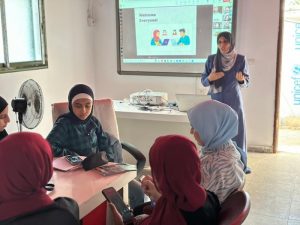
After overcoming significant challenges, such as accessing a reliable internet connection in a warzone, students in Gaza and Manchester have been learning together, and supporting each other through an intercultural exchange project run as part of the University’s MA TESOL (Teaching English to Speakers of Other Languages) degree course.
Through the Voices Beyond Borders project, Chinese students studying at the Manchester Institute of Education have been paired with young Palestinians being taught English in Gaza by a University of Manchester alumnus. The project was enabled by social responsibility funding from the Faculty of Humanities and the School of Environment, Education and Development at The University of Manchester.
The two cohorts met initially over Teams, before being paired up for weekly one-to-one catch-ups via messaging or video calls, with group-to-group meetings every few weeks. These communications not only allow both parties to support each other’s English language development, they also allow both parties to connect on a human level through intercultural interactions.
-
Find out more about this project.