
Driving positive impact: Highlights from our social responsibility overview session
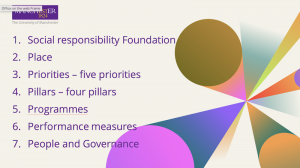 Colleagues from across the University joined the latest Introduction to Social Responsibility and Civic Engagement session on 11 February, which explored how social responsibility will be shaped by the delivery of our Manchester 2035 strategy and showcased examples of social reponsibility in action from all three Faculties.
Opening the session, Julian Skyrme, Executive Director for Social Responsibility and Civic Engagement, outlined how social responsibility now sits as one of the five foundations of our Manchester 2035 strategy. Julian explained the shift from social responsibility being a core value to becoming one of five foundations embedded across research, teaching, practice and operations. He highlighted the University’s five priority areas of social inclusion, prosperous communities, better health, environmental sustainability, and cultural and digital engagement, and reiterated the University’s ambition to remain in the top 1% globally for impact against the UN Sustainable Development Goals (SDGs). Julian also reported strong progress towards the University’s 2038 zero‑carbon target, supported by major operational initiatives including the Medebridge Solar Farm, waste‑reduction schemes, biodiversity work and circular‑economy projects.
Colleagues from each Faculty then showcased practical examples of social responsibility in action. Hawys Williams, Social Responsibility and Public Engagement Manager in the Faculty of Biology, Medicine and Health, highlighted student‑led health clinics that deliver cardiovascular risk checks for staff and students, and a new science‑communication project where final‑year students develop resources for external partners. Dimitris Papadimitriou, Vice-Dean for Social Responsibility in the Faculty of Humanities, provided an overview of the Humanities Strategic Civic Engagement Fund and shared examples such as the ‘Rewilding Our Industrial Past’ project in the Medlock Valley, which has brought staff, students and local communities together to restore neglected green space. Lynne Bianchi, Vice-Dean for Social Responsibility in the Faculty of Science and Engineering, outlined work in the Faculty including LEAF‑accredited sustainable laboratories and major STEM‑outreach initiatives such as the Great Science Share for Schools and Fun Lab.
The session also highlighted the expansion of partner enabled learning, a Manchester 2035 commitment ensuring every taught student can make a positive societal contribution through their programme. Colleagues discussed how assessed partner enabled learning and consultancy projects in health and business education already provide meaningful impact for community partners.
Further discussions covered wider engagement across the University, including the role of the new multi‑faith chaplaincy team and opportunities to incorporate heritage resources and special collections into teaching and civic projects.
- Colleagues who wish to continue exploring opportunities for collaboration, share ideas for new initiatives can connect with the social responsibility team by contacting responsibility@Manchester.ac.uk
- A recording of the session can be viewed here.