
From the sea to your sofa
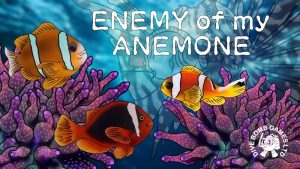 What if the reality of reef ecosystems could be brought to life through play?
That is the question behind Enemy of My Anemone, a new, marine biology-inspired card game created by Dr Andrew Angus-Whiteoak, Technical Operations Manager for the Faculty of Biology, Medicine and Health at The University of Manchester.
Inspired by a love of life under the sea, Andrew set out to create something that would spark curiosity about marine ecosystems while remaining accessible, strategic and genuinely fun to play. The result is a 78-card, fully illustrated deck where players protect clownfish, fend off predators and race against an approaching ecological “apocalypse”.
At first glance, it is a tactical game for two to three players. Look closer, and it becomes a subtle introduction to ecological principles. The relationship between clownfish and anemones mirrors real symbiosis. Predator attacks follow natural population cycles. Competition for shelter reflects the pressures reef species face as habitats shrink.
Scientific ideas are not added on top of the game mechanics. They are the mechanics.
Andrew’s academic journey informs this approach. Originally trained as an artist and printmaker, he was swept away by science, and now manages Technical Operations within the University’s Faculty of Biology Medicine and Health. His professional role involves supporting cutting-edge research environments, managing operations and ensuring systems function reliably and safely. That same operational mindset, attention to detail and commitment to compliance shaped the development of the game.
Accessibility was foundational rather than an afterthought. Andrew’s partner, who is registered blind, collaborated closely throughout development. High-contrast lozenge text boxes, clear sans-serif fonts, and generous font sizing were built into the design from the start. Playtesting included individuals with visual and cognitive impairments to ensure that clarity and inclusion were embedded in the experience. A fully illustrated digital rulebook with alt text and compatibility with screen-reading software will also be made available.
The project also reflects the University’s Social Responsibility commitments. By translating scientific principles into an engaging, shared activity, the game promotes public engagement with research and environmental awareness beyond academic spaces. Production has been kept within the UK to reduce transport emissions. Materials are FSC-certified and recyclable, and all components have passed EN71 safety testing with CE and UKCA compliance. Sustainability, accessibility and civic engagement were treated as design constraints rather than optional extras.
In addition to being an engaging tabletop experience, Enemy of My Anemone has potential as a public engagement and climate education tool. Its mechanics model real ecosystem relationships and pressures in a way that encourages players to ask deeper questions about reef health, species interdependence and environmental stressors. This aligns with broader University initiatives such as Roundview, which explores how education can stimulate climate awareness and action by connecting scientific insight with everyday life. The game has already been used informally in community settings, from local playtests with members of the Manchester gaming community to outreach across community hubs and allotment societies. It holds promise for use in informal learning spaces where ecological literacy and stewardship are being fostered.
Enemy of My Anemone demonstrates how creativity and research culture can intersect in unexpected ways. It connects art, science and community. It turns complex ecological relationships into something tactile and social. And it shows how knowledge generated and supported within the University ecosystem can ripple outward into everyday life.
As reefs face increasing pressure from climate change, pollution and habitat loss, small shifts in awareness matter. A game cannot solve global environmental challenges. But it can start conversations. It can build empathy for species often reduced to headlines. And it can remind us that ecosystems, like communities, depend on balance, cooperation and care.
- From the sea to the sofa, this is science shared. Further details about the project can be found here.