
Big engineering and small changes: two routes to more environmentally sustainable IT
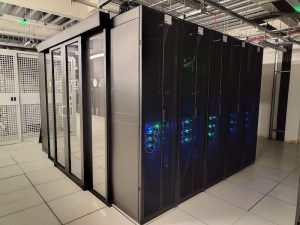 The University’s IT Services has cut carbon emissions and energy costs through two very different approaches: upgrading the cooling infrastructure in a data centre and making a simple change to power-management settings across the student PC estate. The data centre work involved a programme of physical upgrades to specialist infrastructure delivered over several years, while the student PC initiative involved reconfiguring thousands of devices. Together, they demonstrate how environmental improvements can come from initiatives of very different scales and levels of complexity, with both making an important contribution to the University’s wider environmental sustainability ambitions.
Engineering a more efficient data centre
Data centres are among the most energy-intensive parts of our IT infrastructure, making energy efficiency an important opportunity to reduce their environmental impact. Over four years, we implemented a series of improvements, including installing reflective insulation on windows (which helps keep temperatures down in peak summer), LED motion-sensitive lights, modernised air conditioning, and most significantly cold aisle containment.
Cold aisle containment puts a sealed box around the IT equipment, which separates the cold air supplied to it from the hot air it emits, this in turn reduces the need to cool the whole room, and provides more intense cooling to the devices so they don’t have to work as hard to cool themselves.
Together, these measures have reduced our electricity consumption in the data centre by around 50%. This big increase in efficiency reduces our annual Scope 3 carbon emissions by around 165 tonnes of CO₂e, and reduces our electricity bill by around £320,000.
The project shows how investment in infrastructure can deliver environmental and financial benefits simultaneously. The improvements reduce the energy needed to operate the facility, with the resulting energy savings paying back the investment.
Small settings, significant savings across the student PC estate
The second example is very different. Rather than a substantial engineering project in a specialist facility, it comes from a relatively small change applied at scale.
There are around 4,800 student PC devices across the University estate. We reviewed the power-management settings on these devices’ monitors, and wherever technically appropriate, changed them so that the screens automatically enter sleep mode after a short period of inactivity.
The amount of electricity saved by putting a monitor to sleep earlier is insignificant. But multiplied across thousands of devices and thousands of hours through the year, the impact becomes substantial. This one change is saving around 82 tonnes of CO₂e from our Scope 2 emissions and £160,000 in electricity costs every year.
Unlike the data centre work, there was no physical engineering intervention. It demonstrates the opportunities that may be found by looking closely at how our existing technology is configured and operated, particularly when these small efficiency improvement can be repeated thousands of times.
Different approaches, one significant impact
The two initiatives couldn’t be more different, but they follow one shared principle: use the technology we already have more efficiently. Together, they are saving around 247 tonnes of CO₂e annually. To put this saving into perspective, it is equivalent to the emissions from around 380 economy-class passengers flying from London to New York, or around 187,000 days of non-stop Netflix streaming.
John Vass-de-Zomba, IT Environmental Sustainability Manager, explains: “The savings contribute directly to the University’s self-set targets of achieving zero Scope 1 and 2 carbon emissions by 2038 and net-zero carbon overall by 2050. Importantly, these two improvements show that environmental sustainability isn’t separate from running IT well – it is both an indicator and an integral feature of efficiently used IT resources.”