
Hamied Haroon, People of Purpose
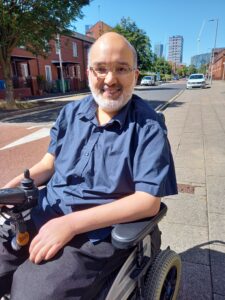 Instead of asking, ‘What is your disability?’, we should be asking, ‘What would help?’
It is a simple shift in language, but for Hamied Haroon, Academic Lead for EDI and disability, it reflects a much bigger change in thinking.
Throughout his years as a student, member of staff and disability advocate at The University of Manchester, Hamied has seen how systems can focus on disclosure rather than support. Instead, the conversation should start with what people need to feel fulfilled and participate fully in our University community.
Hamied Haroon is currently a Senior Technical Specialist in Magnetic Resonance Imaging Physics but started at Manchester studying physics at UMIST (University of Manchester Institute of Science and Technology).
At the time, many parts of the campus were physically inaccessible. Hamied reflects on his time working at the Students’ Union and having to be carried up stairs in his wheelchair to attend meetings. One response was to complete a charity bungee jump in his wheelchair! For Hamied, the message was simple. Disabled people can do all these things if barriers are removed.
While Hamied faced obvious physical inaccessibility as a student, after becoming a member of staff at the University he lost nearly all of the support that had been available to him as a student.
At the same time, the University was developing its disability equality scheme and brought disabled staff together to share their experiences. A clear message emerged: disabled staff needed greater support. Hamied became Chair of the Disabled Staff Network around 2006/7, ensuring the University provides access to more support and resources for staff.
As Academic Lead for EDI and disability, Hamied is focused on bringing together the work currently taking place across the University on disability and neurodivergence and making it more visible. To help do this, he created the Disability@Manchester Hub on Teams, which now has around 200 members from across the University. The platform enables colleagues to share projects, exchange ideas and connect with others working in similar areas. One example is Auracast, a Bluetooth-enabled audio system that could make a real difference for D/deaf and hard of hearing staff, students and visitors in lecture theatres, classrooms and at events.
Despite progress, Hamied believes there is still a long way to go. Raising the profile of disability advocacy remains an important part of his work. He believes disability and neurodivergence can sometimes “fall under the radar” in higher education, as there is no equivalent to charter marks such as Athena Swan or the Race Equality Charter to drive visibility and accountability.
Looking ahead, Hamied is developing a new annual disability lecture for the University. Named the Alf Morris Lecture, after the Wythenshawe MP who pioneered disability rights legislation and became the world’s first Minister for Disabled People, the event aims to celebrate Manchester’s rich disability rights history while strengthening links between the University and disabled people’s organisations across Greater Manchester.
Hamied hopes the lecture will create opportunities for mutual learning and action rather than simply giving the University a platform to talk about disability. Community organisations will be encouraged to showcase their work and share their expertise, helping to build stronger partnerships between the University and the wider region.
Ultimately, Hamied hopes the lecture will reflect the spirit of Manchester’s disability rights movement: bringing people together, challenging barriers and ensuring disabled voices remain at the heart of the conversation.
- Staff and students can join the Disability@Manchester Hub on teams here.