
Making science more inclusive: how student volunteering is breaking down barriers
 How can we make science more accessible, engaging and inclusive beyond the classroom?
Holly Sedgwick is a a fourth-year Wellcome Trust PhD student studying Immunomatrix in Complex Disease at The University of Manchester. Her commitment to public engagement and widening access has helped connect a wide range of audiences with science. Through a diverse portfolio of outreach activity across museums, galleries and public venues, Holly’s work focuses on transforming complex concepts in immunology into engaging, understandable experiences for a broad audience. By taking science beyond the classroom and into community spaces, she has helped to break down barriers that often prevent people from engaging with scientific topics.
Through contributions to major initiatives, including British Science Week at the University’s Manchester Museum, Holly has supported activities welcoming over 1000 pupils from more than 30 schools across Greater Manchester each year, creating opportunities for young people of all ages and backgrounds can explore science in ways that feel relevant and approachable.
A defining strength of Holly’s outreach is her ability to connect with diverse audiences, including school pupils, families, and older adults. Her activities are carefully designed to be accessible and age-appropriate, ensuring that participants can engage meaningfully regardless of their prior knowledge or experience.
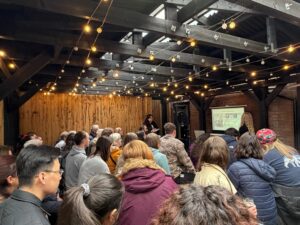
Volunteering as part of the ‘Our Manchester, Our Air’ initiative at Manchester Art Gallery, a city-wide movement focused on tackling air pollution, Holly delivered interactive activities such as immune system games, pipetting demonstrations and lung function testing for school pupils, families and the wider public. She has also played an active role in Pint of Science, an international science festival that brings researchers into local pubs and cafes to discuss their work with the public.
A key strand of Holly’s work has been her involvement in the University of Oxford and Royal Northern College of Music’s ‘Thanks-for-the-Memories’ project. After first volunteering at a Science and Industry Museum event, she went on to support Lydia Becker Institute student lab visits and teacher workshops, delivering practical activities and introducing students to laboratory research. This experience led to a collaboration with the University of Oxford and a fellow University of Manchester student to co-develop accessible Year 9 educational resources focused on vaccination, immune memory and STEM careers. More recently, this work has expanded through a partnership with Oxplore, where these resources are being developed into interactive educational videos to further broaden their reach.
Reflecting on her experience, Holly shares: “Public engagement has been one of the most meaningful and rewarding parts of my PhD. I’m passionate about making science feel accessible, relevant, and inclusive, particularly for people who may not traditionally see themselves represented in STEM, something I personally struggled with before pursuing my own education in science.”