
Community Conversations explores the future of Greater Manchester’s rivers
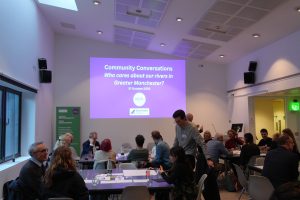 Who cares about Greater Manchester’s rivers? This question was at the heart of the University of Manchester’s third Community Conversations event. Our Community Conversations are a series of events bringing together people with a wide range of expertise to discuss, debate, disagree, and ultimately work together to find solutions for Greater Manchester.
Opening the event, The University’s President and Vice Chancellor, Professor Duncan Ivison emphasised the value of listening across different experiences and areas of expertise: “The spirit of the event is to learn from each other, listen to each other and share knowledge.”
Across the discussions, a shared theme emerged: caring for rivers is a social responsibility as well as an environmental challenge. Their future raises questions about who benefits from investment, whose knowledge informs decisions and how more people can build a connection with the nature around them.
What do we ask of our rivers?
Rivers face many competing demands including water supply, drainage, flood prevention, pollutant removal, conservation and recreation. Dr Stephen Boult, Senior Lecturer in Earth and Environmental Sciences, explored how balancing them is essential for a healthy river, as well as raises social and political questions about what people ask of their rivers.
Dr Ian Thornhill, Senior Lecturer in Planning, Property and Environmental Management, invited participants to look beyond what rivers provide for people and consider them as living entities with which communities have relationships. Drawing on Indigenous perspectives that do not separate nature and culture, he explored how a different understanding of rivers could change the way they are valued and treated.
The human-river relationship also takes shape through everyday experiences. Dr Cecilia Skordilis, Reader in Earth and Environmental Sciences, explored how cultural activities around water can strengthen people’s affinity with rivers and encourage their protection, highlighting the role universities can play through education and support for shared stewardship.
The conversation also reached into the home. Dr Claire Hoolohan, Senior Lecturer in Civil Engineering and Management, highlighted findings suggesting that more than 90% of people would happily use more recycled rainwater at home, while 75% would use water from laundry or showers to flush toilets. Clear responsibilities, fair costs, skills and accountability were also highlighted as essential to making change possible.
Together, these perspectives connected river health with the choices made in homes and communities.
Bringing rivers back into community life
What might a healthier relationship with rivers look like in practice? Discussion turned to restoration, access to nature and how communities can reconnect with a polluted river system through volunteering and time spent in nature.
Dr Keith Hendry, Chair of the Mersey Rivers Trust, described the challenge of reconnecting communities with a severely polluted river system. Volunteering, field-based education and direct encounters with nature were explored as ways to rebuild those connections. The River Medlock at Clayton Vale offered a clear example of such change. Participants heard how restored sections, once brick-lined and devoid of life, now support life again, illustrating how restoration can bring rivers back into view and help communities reconnect with nature.
But the relationship extends beyond the riverbanks: Sam Evans of Greater Manchester Combined Authority, who chaired the civic panel, reported that 60,000 homes face surface-water flood risk and a further 20,000 face river flood risk. He connected these challenges with health inequality and access to green space, placing fairness and shared responsibility at the centre of the conversation.
Sarah Jenner of United Utilities, Alex Clegg of the Angling Trust, Lucy Stowell-Smith of Groundwork Greater Manchester and Katherine Causer of the Environment Agency explored how investment, restoration, citizen monitoring and community engagement could work together. Their contributions highlighted the need to collaborate across whole river catchments (the areas of land that drain into a river).
From shared concern to shared action
No single organisation can meet these challenges alone. Rivers cross administrative and geographical boundaries, connecting ecosystems, infrastructure and communities. Participants explored how scientific evidence could work alongside local knowledge and citizen monitoring, with trusted institutions and meaningful community participation.
Feeding back from table discussions, a plethora of ideas emerged. These included connecting river projects with students, volunteering and developing green skills; co-creating exhibitions about water, culture and river health; and involving artists, poets and musicians.
Closing the event, Professor Duncan Ivison drew together four recurring themes: rivers and relationships; equity and access; knowledge and trust; and culture and practical ambition.
So how can Greater Manchester bring research, community experience and institutional support together to care for its rivers, and make the benefits accessible to the communities around them? The discussions pointed towards a shared challenge: building healthier rivers through stronger relationships with the people and places they connect.
The conversation will continue beyond the event through a follow-up blog by Dr Ian Thornhill. We encourage the continuation of discussions with our communities, colleagues and partners and the sharing of further reflections and ideas for collaboration!